

Updated: August 20, 2026
You know that feeling when you’re brushing your teeth one morning and notice a little pink in the sink?
Maybe you brushed a little harder than usual. Maybe you recently started flossing again. Or maybe you’ve noticed the same thing a few times and wondered whether it means anything.
We understand why it’s easy to brush off. When your gums don’t hurt and your teeth feel fine, a little bleeding may not seem like something that deserves much attention.
But it can be worth checking in.
That’s one reason we appreciate the reminder that comes with National Gum Care Month each September. It gives us a chance to talk about a part of your smile that doesn’t always get as much attention as your teeth.
Your gums are an important part of your oral health, and caring for them goes hand in hand with preventing dental problems and maintaining your smile over time. At DeJesus Dental Group, gum health is part of the personalized general dentistry care we provide at our Bridgeport/Trumbull and Shelton offices.
And if it’s been a while since you’ve thought about your gums, September is a pretty good time to start.
Why Gum Health Deserves a Little More Attention
When people think about dental problems, cavities often come to mind first.
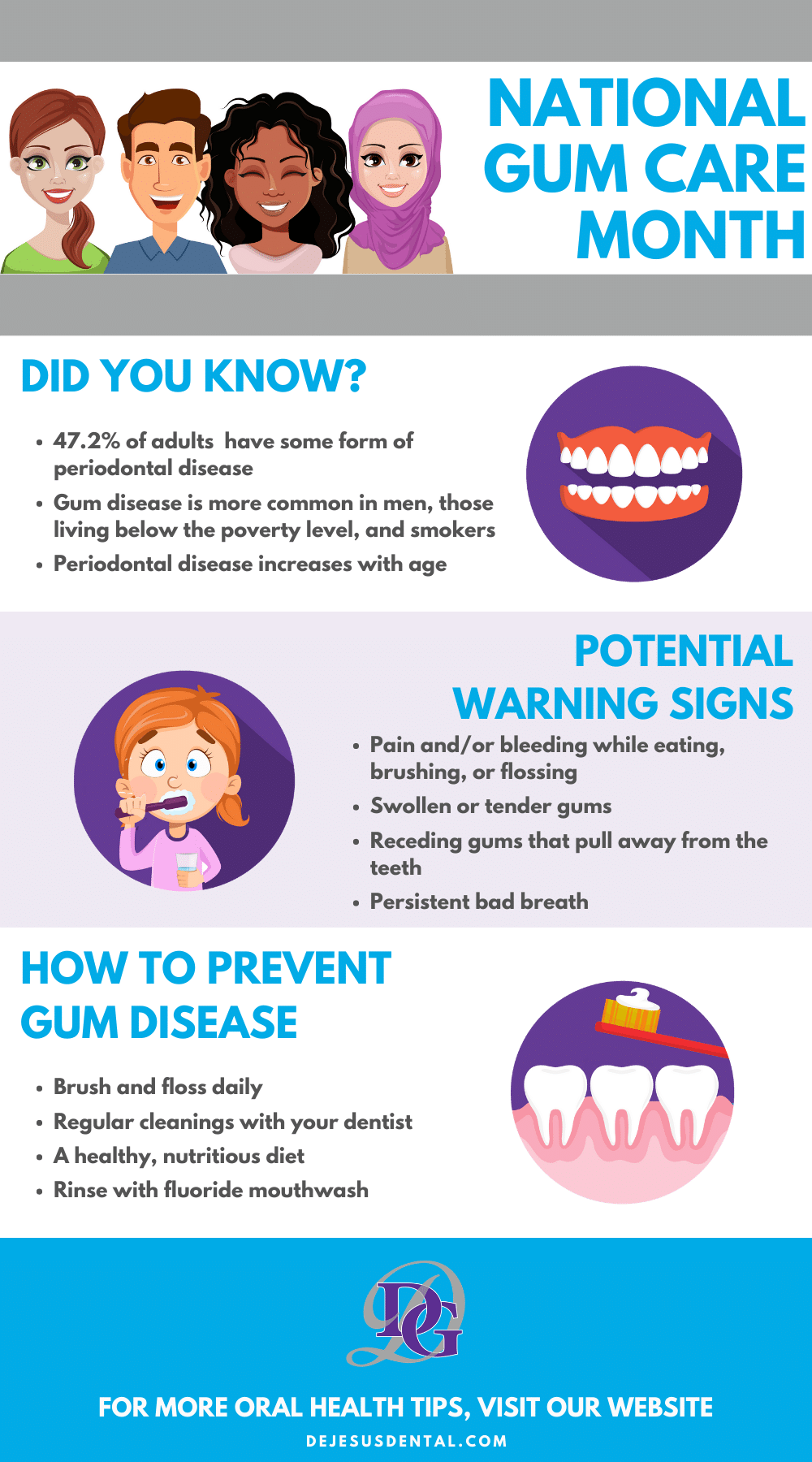
Gum disease can be easier to overlook, partly because the early changes may be subtle. You might notice gums that look redder or puffier than usual, bleeding while brushing or flossing, persistent bad breath, sensitivity, or gums that seem to be pulling away from the teeth. More advanced periodontal disease may also be associated with loose teeth, discomfort while chewing, or changes in the way the teeth fit together.
But here’s the tricky part. Not everyone experiences the same symptoms, and having one of these signs doesn’t automatically mean you have gum disease.
That’s why we’d rather look at the whole picture.
If something has changed in your mouth, a dental evaluation can help us understand what may be contributing to it and whether your gums need additional attention. Sometimes the answer is relatively simple. Other times, closer monitoring or periodontal care may be helpful.
Either way, knowing is usually more reassuring than wondering.
What Is Gum Disease?
Gum disease, also known as periodontal disease, refers to conditions involving inflammation and infection of the tissues surrounding the teeth. Plaque, the sticky film that continually forms on teeth, can contribute to gum inflammation when it remains around the gumline.
The earlier stage is commonly called gingivitis.
With gingivitis, the gums may become red, swollen, tender, or more likely to bleed. When addressed early, gingivitis can often improve and may be reversed with professional care and consistent oral hygiene.
Periodontitis is more advanced.
At that stage, inflammation can affect the tissues and bone that help support the teeth. Treatment may help control the condition and reduce the risk of further progression, but damage that has already occurred may not be completely reversible.
That distinction is one reason we put so much emphasis on preventive care and early evaluation. We’re not trying to make every small symptom sound scary. Quite the opposite.
We want to give you the opportunity to address changes while they may still be easier to manage.
What If Your Gums Bleed When You Brush or Floss?
Seeing blood on your toothbrush can definitely get your attention.
But bleeding gums don’t have just one possible explanation. Gum inflammation may contribute, but brushing too aggressively, changes in your flossing routine, certain medications, hormonal changes, and other health factors may also play a role.
So rather than assuming the cause, we look at what else is happening.
Is the bleeding occasional or frequent? Are your gums swollen or tender? Has your brushing technique changed? Are you taking a new medication? Have you noticed persistent bad breath or gum recession too?
Those details can help us get a clearer picture.
We’ve covered this topic more closely in our guide to possible causes of bleeding gums. If bleeding keeps happening, bringing it up during your next dental visit can help us determine whether it’s related to gum inflammation or something else that deserves attention.
Why Dental Cleanings and Exams Matter for Your Gums
A routine dental appointment may feel like it’s mostly about polishing your teeth and checking for cavities.
There’s more going on than that.
During dental cleanings and exams, we can also pay attention to the condition of your gums, plaque and tartar buildup, areas that may be difficult to clean at home, and signs that could suggest inflammation or periodontal concerns. DeJesus Dental Group’s current dental cleaning services also include care for issues such as bleeding gums and deep cleaning when appropriate.
Depending on your individual needs, a gum evaluation may include measuring the spaces around your teeth and looking for changes such as gum recession, bleeding, tooth mobility, or bone changes on dental X-rays when those images are appropriate. These findings can help a dental professional assess periodontal health and determine whether routine preventive care is enough or additional treatment should be considered.
And this is where having an ongoing relationship with a general dentist can be especially helpful.
Your mouth changes over time. When we see you regularly, we have the opportunity to compare what we’re seeing today with what we’ve seen at previous visits. A small change may mean very little on its own, but a pattern can give us useful information.
When a Routine Cleaning May Not Be Enough
Sometimes routine preventive care and improvements to your home routine may be enough to get gum inflammation moving in a healthier direction.
But gum disease isn’t one-size-fits-all.
If buildup and inflammation extend below the gumline, a deeper type of cleaning called scaling and root planing may be recommended. This approach is designed to remove plaque, tartar, and bacteria from areas beneath the gumline and around the tooth roots.
DeJesus Dental Group offers non-surgical gum disease treatment, with the approach tailored to the condition of the gums and the individual patient’s needs. The practice’s current service information includes professional cleaning, scaling and root planing, and other non-surgical periodontal options when appropriate.
Here’s how we look at it: two people can both notice bleeding gums and still need very different care.
One person may be dealing with relatively mild inflammation. Another may have deeper periodontal pockets or other changes that call for closer monitoring or treatment.
That’s why we start with an evaluation rather than assumptions.
Small Everyday Habits Can Support Healthier Gums
Healthy gum care doesn’t have to turn into an elaborate routine.
Brushing your teeth twice a day and cleaning between your teeth regularly can help control plaque around the gumline. Depending on your mouth and your preferences, cleaning between the teeth may involve traditional floss, interdental brushes, or other tools recommended by your dental team.
And honestly, we’re much more interested in helping you find a routine you can maintain than expecting perfection.
Maybe traditional floss feels awkward. Maybe you have dental work that makes certain spaces more difficult to reach. Maybe your gums are sensitive and you’re worried about making them bleed.
Tell us.
We can talk through technique, tools, and habits that may fit your needs better.
Because missing one night doesn’t define your oral health. What matters more is the pattern you build over time.
Lifestyle and health factors can matter too. Tobacco use and conditions such as diabetes are among the factors associated with periodontal health, which is one reason keeping your dental team informed about changes to your overall health, medications, and habits can be useful.
Your mouth is part of a much bigger picture.
How Often Should You Have Your Gums Checked?
This is one area where we don’t like one-size-fits-all answers.
You may have heard that everyone should automatically see the dentist every six months. For some people, that schedule works well. Others may benefit from a different interval based on their gum health, history of dental problems, medical conditions, risk factors, and the type of care they’re receiving.
If someone has been treated for periodontitis, for example, more frequent periodontal maintenance may be recommended based on individual needs.
So rather than focusing on a universal number, we prefer to build a preventive schedule around you.
That personalized approach is a big part of general dentistry at our practice. Preventive care works best when it reflects what’s actually happening in your mouth, not simply what works for somebody else.
Gum Care for Patients in Bridgeport and Shelton
We know getting dental care onto the calendar isn’t always simple.
There’s work. School pickups. Family responsibilities. Medical appointments. And sometimes dental anxiety makes that calendar reminder even easier to postpone.
We get it. That’s why our goal is to make the conversation about gum health feel practical and supportive, not judgmental.
DeJesus Dental Group provides general dentistry and gum care from two Connecticut locations. Our Bridgeport dental office is located on Main Street in Bridgeport near the Trumbull line, while our Shelton dental office is located on River Road in Shelton.
Whether you’ve kept up with your dental visits or it’s been longer than you planned, you can start with where you are today.
Maybe you’re concerned about bleeding gums. Maybe your gums have started to recede. Maybe you’ve noticed persistent bad breath. Or maybe nothing feels wrong and you simply want to stay on top of your oral health.
Those are all reasonable reasons to check in.
Frequently Asked Questions About Gum Disease
Can gingivitis be reversed?
Gingivitis can often improve and may be reversible when it’s addressed early through professional dental care and consistent oral hygiene. How quickly the gums respond can vary from person to person.
Can periodontitis be reversed?
Periodontitis is a more advanced form of gum disease that can involve loss of the tissues and bone supporting the teeth. Treatment may help manage the condition and reduce further progression, but damage that has already occurred may not be reversible.
Does bleeding while brushing always mean gum disease?
No. Bleeding gums can have several possible causes. However, frequent or persistent bleeding can be associated with gum inflammation and may be worth discussing with your dental team, particularly if you’re noticing other changes at the same time.
Is gum disease always painful?
Not necessarily. Gum disease may develop without significant discomfort, especially earlier in the process. That’s one reason dental exams can be useful even when everything seems to feel fine.
Will everyone with gum disease need a deep cleaning?
Not necessarily. Treatment depends on the type and extent of the gum disease and other individual factors. Some people may need changes to preventive care and home habits, while others may benefit from scaling and root planing or additional periodontal treatment. An evaluation helps determine which approach may be appropriate.
Let National Gum Care Month Be a Simple Reminder
National Gum Care Month doesn’t need to become another complicated health project.
Think of it as a reminder to pay attention.
The next time you brush your teeth, take a second to look at your gums. Have you noticed recurring bleeding? Do they seem swollen or tender? Has your gumline changed? Is there a concern you’ve been meaning to ask about?
And if it’s been a while since your last dental visit, that’s okay too.
At DeJesus Dental Group, we provide personalized general dentistry and gum disease care for patients at our Bridgeport/Trumbull and Shelton locations. We’ll take a look at what’s happening, explain what we see in straightforward language, and talk with you about options that make sense for your individual needs.
No lectures. No assumptions. Just a chance to understand your gum health a little better and decide what comes next together.
If your gums have been trying to get your attention, September may be a good time to listen.
Contact DeJesus Dental Group to schedule a visit.